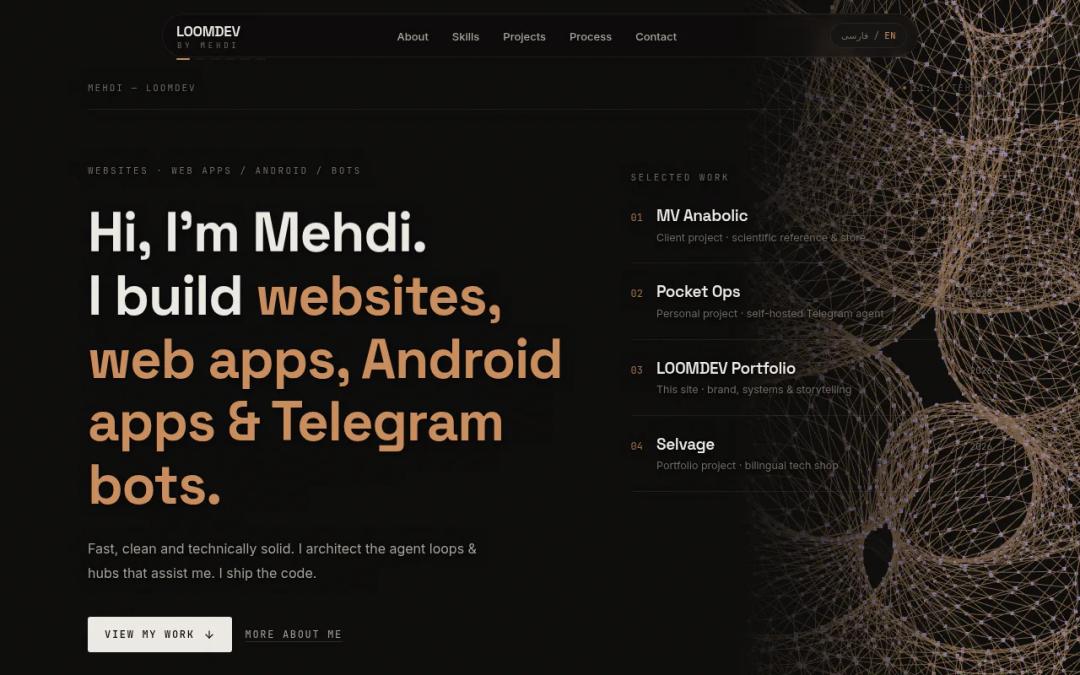
WEBSITES · WEB APPS · ANDROID · TELEGRAM BOTS
I build agent loops. Eden Hub is my multi-agent lab: builders run in parallel, critics review the merged work, and one leader ships a single clean answer.
Fast, clean and technically solid. I architect the agent loops & hubs that assist me. I ship the code.
Selected work
- 01MV AnabolicClient project · scientific reference & store2026
- 02Pocket OpsPersonal project · self-hosted Telegram agent2026
- 03Eden HubPersonal project · multi-agent lab written in Rust2026
- 04LOOMDEV PortfolioThis site · brand, systems & storytelling2026
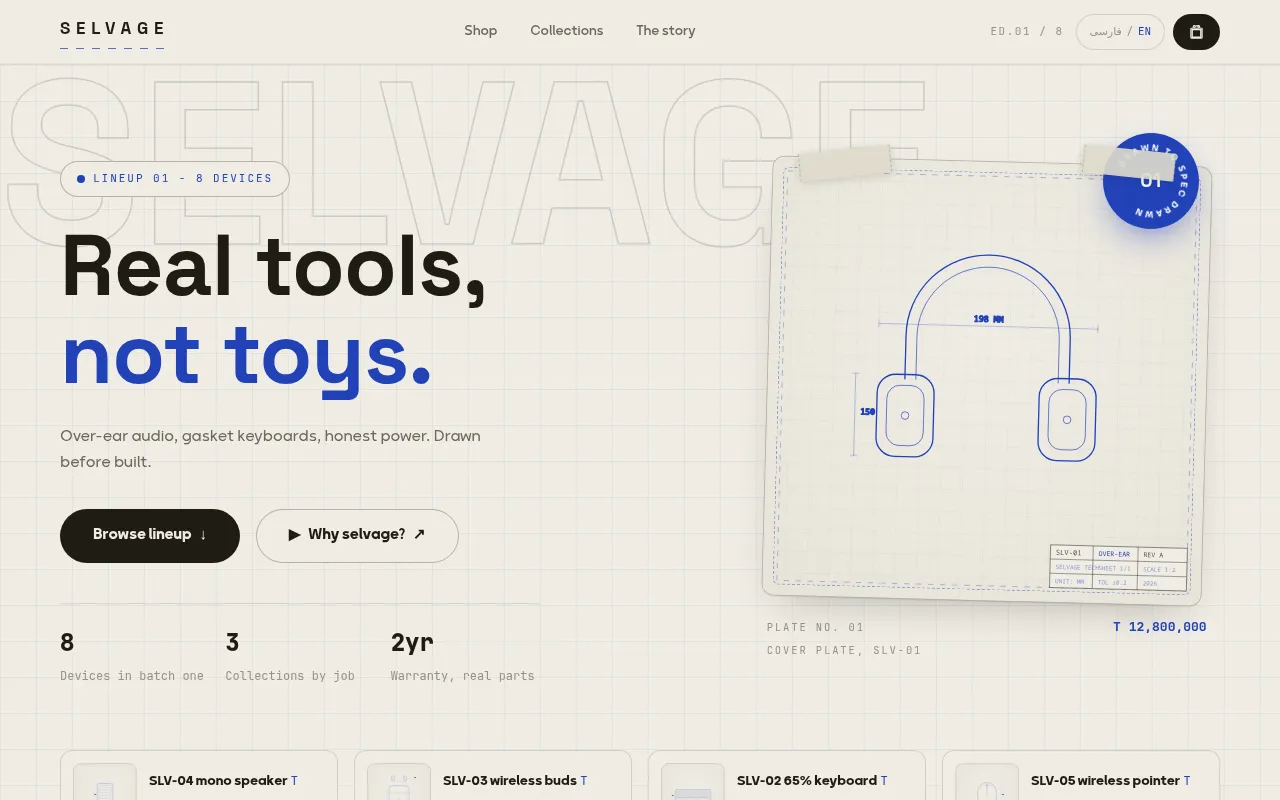
- 05SelvagePortfolio project · bilingual tech shop2026
I'm Mehdi. I build websites, web apps, Android apps and Telegram bots. I got into this because I like turning an idea into something people can actually use.
I pick tools based on what the project needs, not what's trending. The goal's always the same: something fast, clean, and reliable that does its job.
Day to day I work with AI: I run my own agent loops and hubs for research, first drafts, and reviews. Helpful for speed, but the calls and the final code are still mine.
What I actually do differently
The problem first. Tools second.
Before reaching for a framework, I want to understand what we're actually solving. The tech follows from that.
Keep it simple, but not lazy.
I don't add complexity for its own sake. If a straightforward solution works, that's what ships.
I design the loops. They do the legwork.
My agent loops and hubs handle the repetitive bits: research, scaffolding, reviews. They move things along, I make the important calls.
I follow through.
From the first conversation to the last deploy, I stay with it. If something breaks, I fix it.
Where AI actually helps me
Agents assist, I decide.
For me AI is a workshop, not a shortcut. I set up the loops and hubs, they handle the repetitive work.
Research, first drafts, boilerplate, reviews. They move it forward. I stay on the decisions that matter and ship the final code.
The flow
- 01IDEAIdea & problem
- 02HUMAN DECISIONHuman decision
- 03AGENT LOOPSLoops & hubs assist
- 04CODE / REVIEWI ship the code
- 05REAL PRODUCTReal product
Human decides · Loops assist · I deliver
The tools I actually use
Every tool here has earned its place in real projects, not just on a list.
FRONTEND
- Next.js
- React
- TypeScript
- HTML
- CSS
- Tailwind CSS
- SEO
AI & AUTOMATION
- LLMs
- RAG
- Agent Loops
- Agent Hubs
- MCP
- AI-assisted Development
TOOLS & INFRASTRUCTURE
- Git
- Docker
- Linux
- GitHub
- CI/CD
BACKEND
- Node.js
- Next.js APIs
- REST APIs
- Authentication
DATABASE
- PostgreSQL
- MongoDB
- Redis
TELEGRAM BOTS
- Telegram Bot API
- Webhook Bots
- Inline & Payment Flows
MOBILE
- Android
I'd rather show than list technologies.



How a project goes from idea to launch
5 steps · discover → ship
DISCOVER
Understand what we're actually building and why.
PLAN
Figure out the structure and the technical approach.
BUILD
Build it — the stage where the idea becomes a product.
TEST
Test against real failure cases so it holds up in production.
SHIP
Launch it, and stay with it after release.
There's a person behind all this code.
When I'm not coding, I'm usually trying out a new tool, turning a small idea into a side project, or following a fresh curiosity I only just picked up.
I tend to put a new tool to work first and read the docs after. Sometimes that pays off; sometimes it teaches me exactly what not to do next time.
- Mehdi
What I'm working on right now
Better seen than described.
What working together looks like
Every project starts with a conversation. No templates, no fixed packages.
01 · LANDING
One-page site
A focused single-page site, designed and built from scratch.
Usually 1 to 2 weeks
02 · FULL SITE
Full website
A multi-page site with a CMS, SEO and bilingual support if needed.
Usually 3 to 6 weeks
03 · PRODUCT
Web app / Android
Depends on the project. We start with a discovery call and agree on a plan before anything else.
Scoped together
04 · BOT
Telegram bot
A custom bot for your workflow: orders, payments, support, notifications, automation.
Usually 1 to 3 weeks